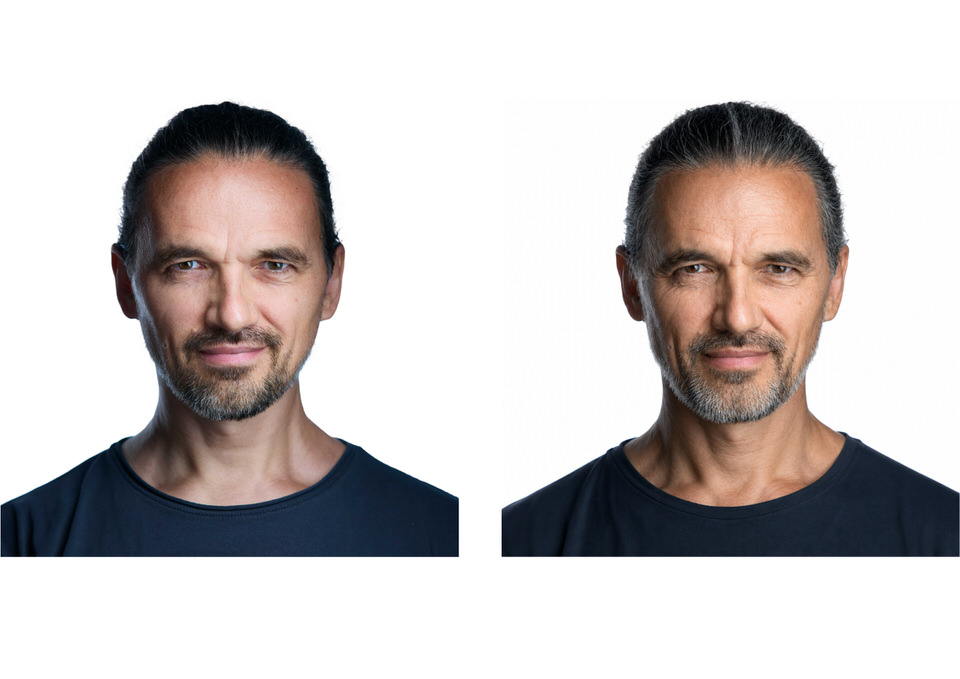
This is probably the most common question I hear as a headshot photographer.
"What do you think about AI headshots?"
(Asked, I assume, on the premise that I should feel threatened – by a huge competitor doing what I do, more efficiently, for a fraction of the price.)
Well, there are several reasons why you might not want to let AI ruin your personal brand, and I'll walk you through them below.
But first, let me tell you when using AI headshots actually is a good idea.
When AI headshots make sense
I haven't run the precise numbers, but from browsing LinkedIn daily, I'd estimate that maybe 1% of users have a real professional headshot. Another 9% have some kind of photo taken with the intention of being used this way. The remaining 90% just use whatever they have on their phones or laptops – something with a vague resemblance to themselves. You probably know this better than I do, because – like I said – there's a 90% chance that's exactly the kind of profile picture you have right now. You're not thrilled about it, but it's been sitting there for years.
Back to the point: 90% of LinkedIn users have never had a headshot session in their lives. They have no idea what it looks like, what to wear, or what to expect – and that's where AI-headshot generators come in.
You upload a dozen selfies, type in a prompt – "I want myself in a navy blazer against a 33% gray background" – and within seconds, you get a result. You can tweak colors, swap outfits, and play with backgrounds, getting an IMPRESSION of how it MIGHT look in real life.
Those two words are capitalized on purpose. What you get from an AI generator should be treated as samples – visual references to help you prepare for a real portrait session. Not as final images to drop on LinkedIn, your website, or anywhere else you represent your personal brand. AI is a fast, cheap, convenient way to preview an idea without committing to a full studio session.
That's the legitimate use. Now let's talk about what actually happens.
What actually happens
People don't use AI headshots as samples. They use them as the real thing.
And at first glance, it looks like a great deal: for about €25, you get 100 AI headshots. Compared to a real session – €300–€500 for 2–4 final images – it looks like an obvious win.
But it's not about what you save. It's about what you lose.
Yes, you saved €475 by going with AI. And those €475 disappeared into daily expenses by the end of the month anyway – a little of this, a little of that, the usual. Meanwhile, your shiny new AI headshot is now all over the internet, and you're doing your best – like we all do – to grow your visibility.
Here's the problem.
Your audience can tell
AI is genuinely good at generating portraits now. But the truth is, AI has existed on Earth for less than five years. Our brains are the product of millions of years of evolution, fine-tuned to read facial expressions because it was a survival mechanism: Is this a friend or an enemy? We read emotion faster than we form conclusions. The description might be perfect, but if the eyes say fake – it's fake.
I'll explain why. The nature of a photograph and an AI-generated image is fundamentally different.
A photograph is the result of light bouncing off a three-dimensional human being, passing through a lens, and landing on a flat sensor at an exact moment in an exact place. It's a record of something that actually happened.
And there's more to it than just the image. A photo session is a lived experience – one that can't be generated, only felt. You stand in front of the camera, watch yourself transform in real time, and walk out with something most of my clients describe as life-changing: a real sense of how they actually look. That kind of confidence isn't something AI can hand you. It's something you build, in the moment, from the inside.
An AI-generated image is the product of analyzing flat photographs of a person taken in the past, combining them with the AI's general knowledge of how a person of that age, gender, ethnicity, and so on might look on average, and blending it all into a new composite. Which – as you've probably already guessed – has nothing in common with reality, no matter how "perfect" it looks.
"But AI is getting better"
It is. AI is improving at a pace nothing human-made has ever matched, and I have no doubt that in the near future, even AI itself won't be able to tell a real photograph from a generated one. So why bother sitting for a session with a human photographer at all?
Here's the thing.
It's like a fake luxury watch. You paid $100 instead of $10,000. No one can tell – except maybe an expert with a loupe. But one person always knows.
You.
The legal angle
And if creative arguments aren't enough, here's a more measurable one.
The result image you get from an AI generator and use to illustrate your personal brand is not protected by law the way a photograph is. A studio photograph comes with a clear contract and enforceable rights over your likeness – you know who created it, you know how it can be used, and you can do something about it if those terms are broken. Your AI-generated image lands in a legal gray area where you have none of that protection.
And it goes further. The photos you upload to train the generator typically feed into the AI's dataset. Your face becomes part of a training set you can never trace, retrieve, or delete. Once it's in there, it's in there.
A studio photograph gives you control over your image. An AI generator quietly takes that control away.
Conclusion
I've put enough words in here. Let's get visual.
Back to the photo at the top. That's the result of asking ChatGPT to picture me at 51, based on a real headshot I provided. I'd call it a clean experiment – the AI is generating a headshot from a headshot, so there's almost no variation in angle, proportions, or background. And I'm actually 51 in that photo.
But ChatGPT thinks I should look like the guy on the right.
Enjoyed this article? Subscribe to the newsletter and get a free book